When to Witness the Great Migration
The Optimal Times to Witness the Great Migration Each Month
There is no single time of year to see the Great Migration since it is an eternal annual cycle from place to place, year in and year out. However, depending on either the aspect of the Great Migration you want to witness (such as river crossings), or the time of year that you prefer to travel, your safari can be tailored to give you the best chance of seeing what you desire. The Great Migration can be summarised in this way as having these four seasons. Alternatively, you can learn more about when to travel via through this month-by-month breakdown of the Great Migration. Whether the great herds are calving in the south or on the move north in search of greener pastures – and then back again – there is a huge variety of astounding scenes unfolding before you.

The Great Migration seasons
Witnessing the Great Migration is a year-round experience. While historic migration patterns can provide insights into the herds’ whereabouts, the movement of these wild animals is ultimately influenced by unpredictable factors such as annual rainfall. Our company provides guests with prime opportunities to observe the migration up close while on safari, with accommodations strategically located along the migration route.
Learn more below about the different season of the Great Migration:
January to March: calving season | April to mid-June: the trek north | Mid-June to November: river crossings | December: calving begins

January - March: The Calving Season Continues
During December and January, the southern plains of the Serengeti and the westernmost regions of the Ngorongoro Conservation Area become lush with fresh, sweet grasses, providing ample grazing opportunities for the wildebeest herds. They spend this time around Ndutu and the northern Ngorongoro Conservation Area, preparing for the upcoming calving season.
In February, a remarkable phenomenon occurs as over 80% of fertile female wildebeest give birth within a short window, typically between late January and mid-March. This period sees the birth of over 500,000 calves, attracting a multitude of predators eager to prey on the vulnerable newborns.
As March arrives, the wildebeest herds remain in the southern area of the park, but preparations are underway to move north as the plains begin to dry out.

April to mid-June marks the season of the trek north and the rut
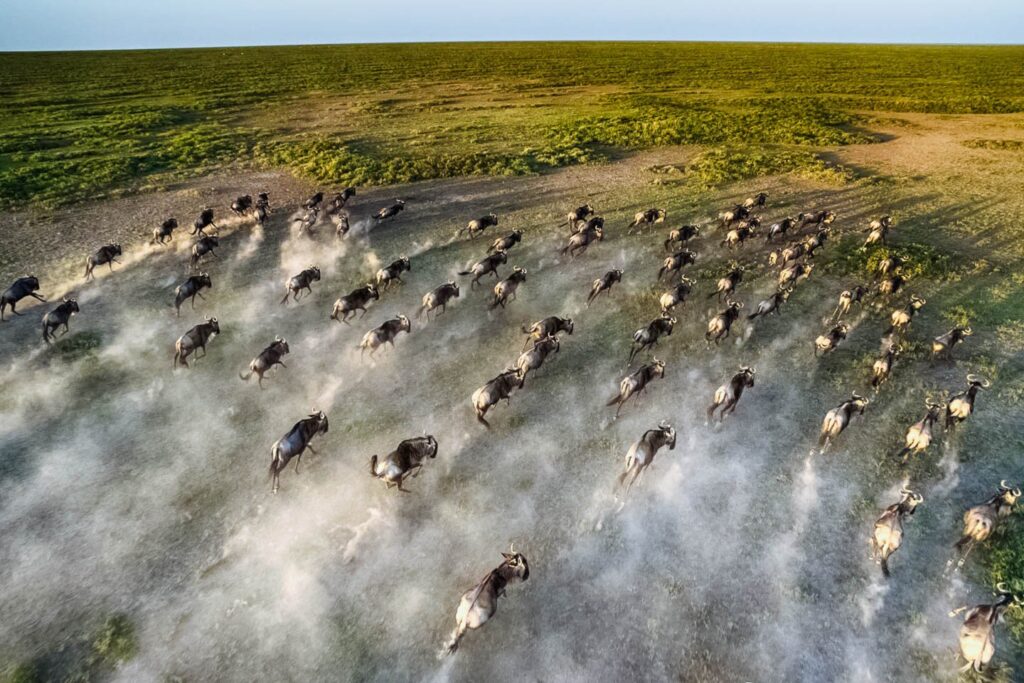
As the rains subside and the land dries up, the herds embark on their journey northward into the central Serengeti, where the grass remains fresh for grazing and nurturing their young. Moving gradually, they feed along the way, taking advantage of the lush vegetation. Meanwhile, the mating season commences, and male wildebeest engage in intense battles for mates. Amidst the rut, the migration persists, with some herds venturing westward into the Western Corridor, crossing the Grumeti River.
- April: The wildebeest set off on their northward migration through the central Serengeti, leisurely grazing as they progress.
- May: Witness the awe-inspiring spectacle of endless columns of wildebeest streaming through the Moru Kopjes in the central park region.
- First half of June: Large gatherings of wildebeest congregate along the southern banks of the Grumeti River in the Western Serengeti, poised to confront the challenge of crossing the crocodile-infested waters.

From mid-June to November, the Serengeti hosts the iconic Great Migration river crossing season
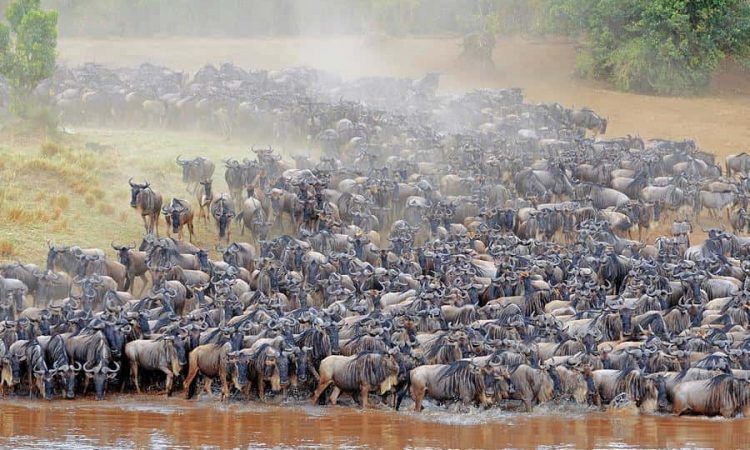
As the herds journey northward towards the Serengeti, the anticipation builds for the thrilling river crossings, often regarded as the highlight of the Great Migration. While typically beginning in July, the timing of these crossings hinges on the whims of the weather.
In the Northern Serengeti and Kenya’s Masai Mara, the spectacle unfolds as the herds navigate the Mara and Talek rivers, showcasing dramatic scenes of survival and perseverance.
Later in the season, the herds reverse course, returning to the Serengeti’s fertile southern plains. Their swift movement covers vast distances each day, culminating in their arrival at Ndutu by early December, where the calving process begins anew.
- July: The migration gains momentum, with vast herds spreading across the Western corridor. The first arrivals reach the North in early July.
- August: As the dry season looms, the herds confront the formidable Mara River, facing challenges but bolstered by the birth of thousands of calves.
- September: Concentrated mainly in the Maasai Mara, the herds continue their northernmost journey, though some remain in the Serengeti.
- October: The herds face the Mara River again, braving its swollen waters on their southward trek.
- November: With the arrival of the short rains, the herds journey back southward, drawn to the revitalized grasslands of the Serengeti.

December: Calving Season Begins
The herds gather on the short grass plains of the southern Serengeti and the northernmost areas of the Ngorongoro Conservation Area. Around February, an estimated 500,000 calves are born within a two- to three-week period. This mass calving event attracts a large number of predators eager to prey on the vulnerable newborns.
The Great Migration from January to December
Learn more below about historical patterns that predict where the Great Migration is each month:
January | February | March | April | May | June | July | August | September | October | November | December
January
Wildebeest start to assemble in the southern plains, spanning from Moru in the north to Naabi, Kusini, and Ndutu. The short grasses in this area are nutrient-rich, containing phosphorus and magnesium from the volcanic ash present in the calcrete layer beneath the shallow soil. It’s advisable to pack waterproof gear as the region often experiences intense thunderstorms. Early sightings of calving may be possible, offering a rewarding experience.
February
February marks the peak of the calving season, offering a breathtaking spectacle as hundreds of thousands of newborn wildebeest take their first steps amidst the stationary herds. These newborns can be spotted across the Ndutu and Kusini plains, extending towards the Ngorongoro Highlands. While February is the driest month of the rainy season, occasional sparse showers may still occur.
March
As the calving season nears its end, the herds remain mostly stationary in the Ndutu-Kusini area, with some venturing further south into Maswa and east towards Namiri Plains. It’s essential to keep your camera close, especially in the predator-rich areas, as the last of the wildebeest calves are born amidst heavy regional thunderstorms.
April
In this final month, you’ll have the opportunity to witness the massive herds, including the newborn calves, leisurely grazing on the plains in the Naabi and Kusini areas. They’ll be maximizing their intake of the remaining nutritious grasses like Digitaria, Sporobolus, Andropogon, and Cynodon before embarking on their challenging journey north.
May
Beginning this month, the wildebeest will embark on a continuous journey northward, traversing from the Moru Kopjes towards the Western Corridor. Persistent dramatic thunderstorms, ideal for photography, continue to provide water to the medium-to-tall Pennisetum and Tussocky Themeda grasses that now sustain the herds. Although the vegetation offers slightly less nutrition, it prompts the animals to continue their movement northward.
June
The Great Migration is in full swing, swiftly traveling up through the Western Corridor and Grumeti Reserve. It’s peak rutting time, marking the beginning of the dry season, although localized showers may still occur in the north. From now on, the animals’ nutrition largely depends on the growth stage of the Digitaria, Pennisetum, Eustachys, and Themeda grasses anchored in nutrient-rich clay amid the woodlands.
July
For wildebeest, the grass truly appears greener on the other side — of the Mara and Sand rivers, that is. Crossings at these rivers are the stuff nature documentaries are made of, and a stay at Sayari ensures you’re perfectly positioned to witness the action. The head of the herd will have reached the Kogatende area in the northern Serengeti, poised to navigate the Mara and Sand rivers, where hungry crocodiles lie in wait.
August
For the most part, herds will migrate from south to north, enticed by the more nutritious grazing on the northern side, courtesy of earlier showers. However, some crossings also occur in the opposite direction. For spectacular sightings of the majority of the wildebeest herds, interspersed with dazzles of zebra and herds of antelope, head to the Lamai Wedge and Nyamalumbwa Plains.
September
In September, river traffic flows in both directions between Kenya and Tanzania, though a southerly direction will dominate by the end of the month. This treacherous traverse is one of nature’s greatest and most tragic spectacles, with tens of thousands of animals perishing in the attempt. Rain continues to evade the southern regions, while sparse showers persist in the north.
October
As thunderstorms begin in the north, the tail end of the herd crosses the river from Kenya down into Tanzania. Meanwhile, the bulk of the animals are moving back down into the Lobo Valley region and Grumeti Reserve, tracing their epic annual circle back south toward their calving grounds.
November
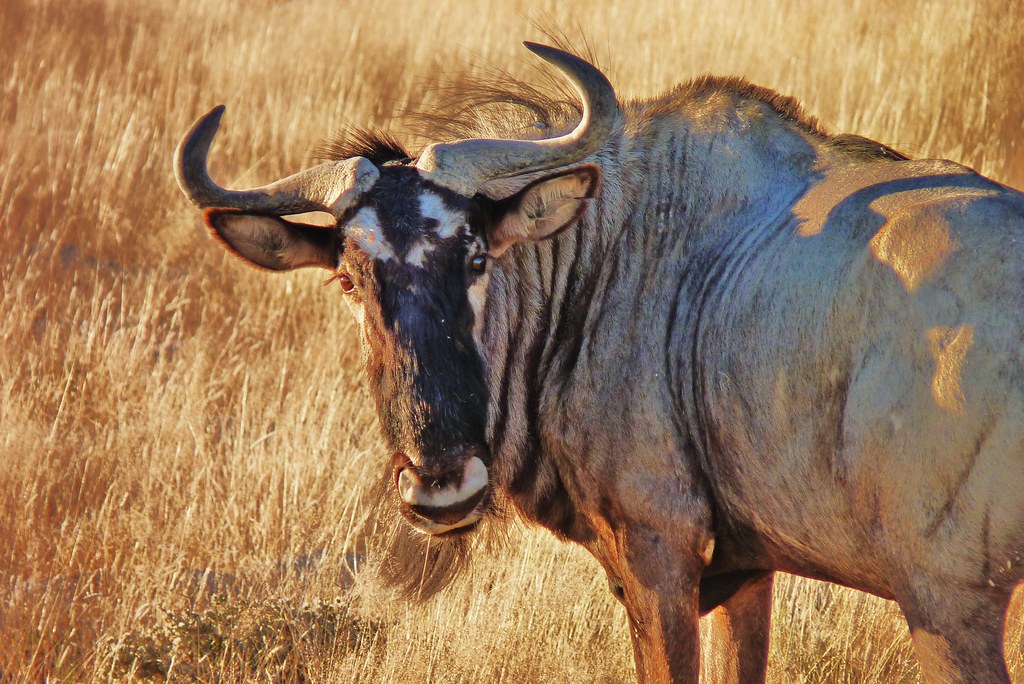
Continuing their journey, the herds have largely left the north and are passing through the Lobo region toward the central Serengeti. Rain is still scarce here, and the nutrition inherent in the grasslands is less than ideal. Interestingly, the reason the wildebeest can still share grazing land with zebras is because the two animals consume different parts of individual blades of grass.
December
Now dispersed across the central Serengeti, from as far north as Lobo to the southern reaches of Ndutu, the Great Migration continues its journey. The rains finally catch up with the still-moving herds, bringing intense thunderstorms and localized showers across the region. The animals have returned to the more nutritious grasslands, including Pennisetum, Sporobolus, Andropogon, Cynodon, and Themeda, as they prepare to calve in the south and begin the great cycle all over again.